Marcus Zayit | Multidisciplinary Artist
Work development process


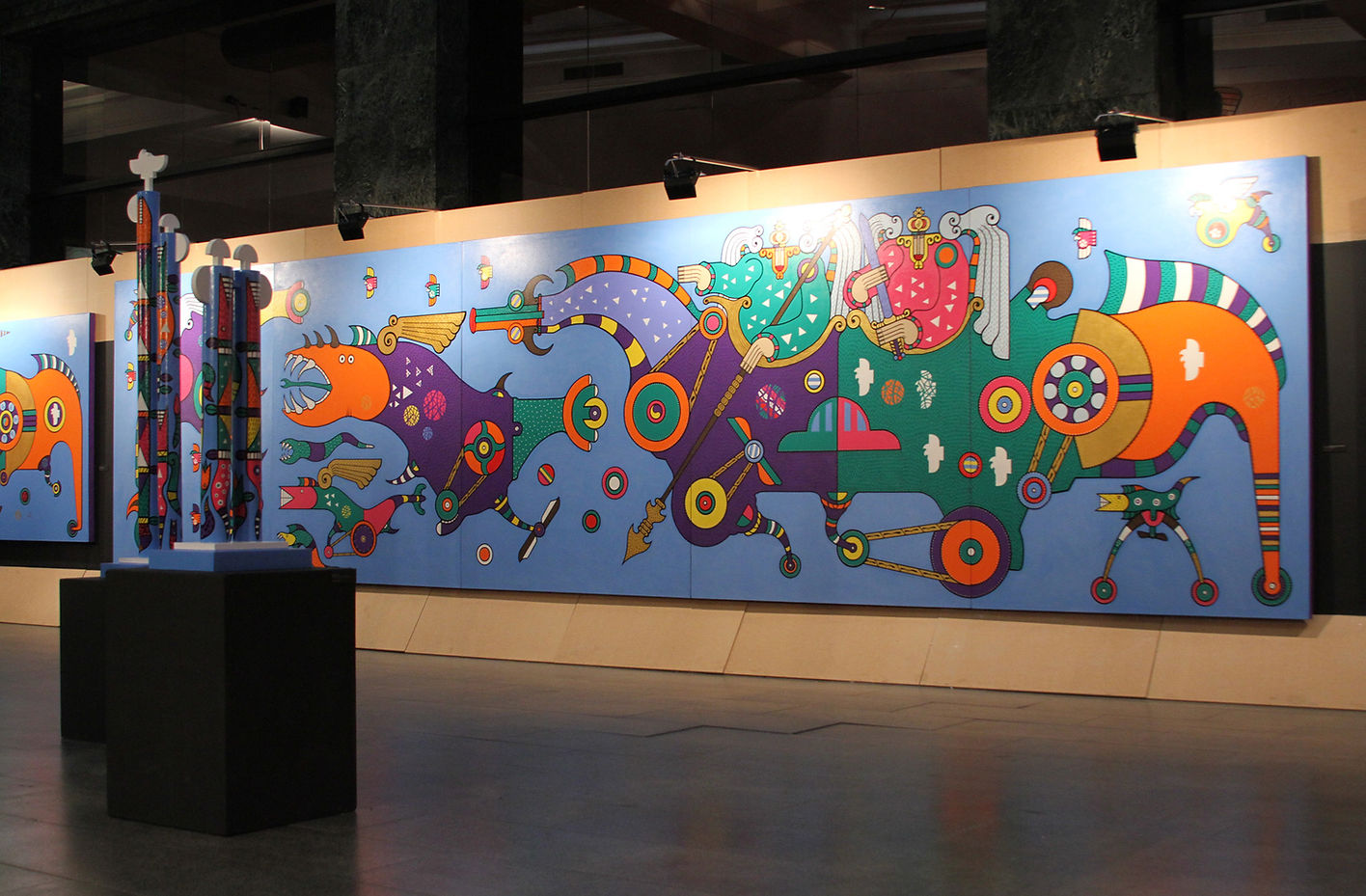
View of the exhibition "About Angels, Saints and Warriors" – Caixa Cultural São Paulo, SP, 2012.
ABOUT ANGELS, SAINTS, AND WARRIORS — BETWEEN THE PROFANE AND THE SACRED
Marcus Zayit belongs to a world whose historical-social context results in a people with a consciousness and attitude of deep religiosity: he was born in the hinterlands of Bahia, in Northeast Brazil, a region with roots deeply entwined in Portuguese culture of the remote Middle Ages, and an ingrained messianism/Sebastianism. These elements can be found in the folk tradition of cordel literature—the woodcut-illustrated poetry booklets that mirror medieval romances, including their musical and linguistic sonorities. His African ancestry, which initially helped define his work, is another guiding factor. In this exhibition, however, we observe that he gradually abstracts himself from these bonds, constructing his own iconography. Self-taught, Marcus was forced to invent, on his own, the resources through which he began to express himself: drawing, forms, the application and distribution of paint, composition, and space, in search of an order uniquely his own.
There are many paths that unveil his work, from technical/formal procedures to aesthetic and symbolic ones; from unreal characters and myths to the harmonization and interplay of colors in space; from the gentle rhythm of flat brushstrokes to the accentuated contour of forms; from the striking coloring of the background to the meanders of figures that intertwine in unrealities. Based on the observation of a completed work, combined or not with quick research on themes of his interest and life experience, he records what is within reach of his eyes and imagination, always seeking to update his expressiveness and reach increasingly higher levels and deeper steps, following his goal of transposing a world rich in unrealisms onto the canvas.
Marcus Zayit builds a mythic and mystical pantheon of saints and angels, closer to the world of men, much like the Greek and African gods who often descended to earth to love, fight, coexist, and enjoy mundane things. To his pantheon, he also brings dragons and beasts, symbols of the power of gods and humans over everything and everyone, and over evil—perhaps in the expectation of salvation. In this space, Marcus builds his art—very particular, very personal—which can now be seen in this exhibition at the Caixa Cultural Center - SP.
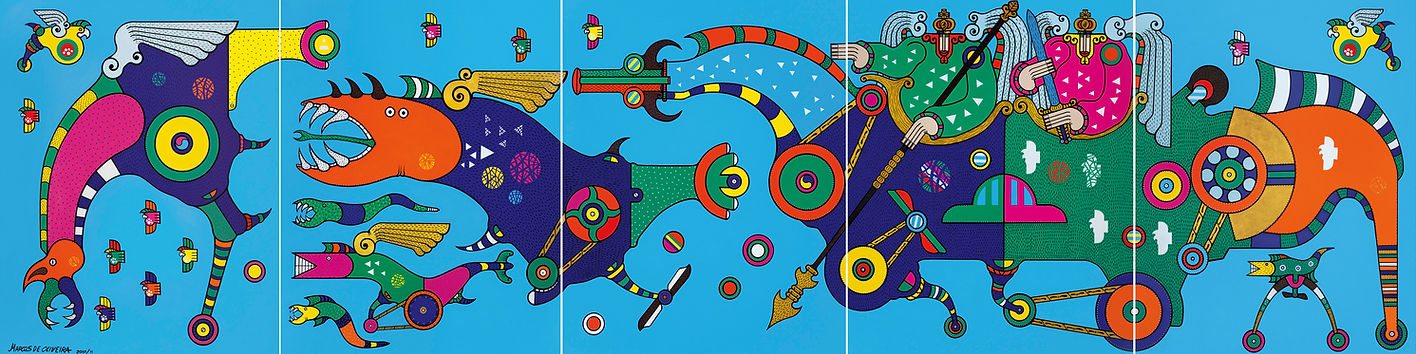
His painting reveals a transcendent religiosity with images laden with a sense of the sacred and an iconography that approaches Byzantine art, painted in the foreground, without perspective. There is clarity and precision in execution, in defining the figures, structuring the composition, and meticulously choosing colors; magic scenes where human figures, angels, saints, warriors, dragons, and serpents integrate, giving rise to unexpected images. Always with formal rigor, these scenes incite inquiry, reflection, and a more accurate analysis of their representativeness.
Analyzing the language of forms, we immediately perceive the limiting contour of the figures: "I always use a special brush of the same number so as not to differ the strokes; to avoid trembling, I keep my hand steady and glide the brush over the canvas without interruption." Through a wide and firm line, the artist simultaneously delimits the space between the character and the background, between form and color, integrating them without any kind of tension. They are one and the same; they have no life if isolated—the characters conform to the color planes. These are vigorous, perfect contours, drawn freehand. To them, he adds small strokes as if to break their supposed hardness. Our eyes, however, do not fixate on a single form but rather wander through them, through the space, the colors, and the composition, inquiring about the fantastic figure: what could it mean? Curiosity is awakened; emotion is present. Marcus Zayit sculpts forms (angels, men, animals, saints, and warriors) as if they were fantastic beings born from his mind, dominating our gaze and making our imagination take flight.
His canvases, now moving beyond the tropical palette of his early production, seek a greater lightness of color. Color dominates the composition. Chromatism has a life of its own, almost seeming to swallow the figures that join it; the artist intends a different perception of color, transcending its own value. The extremely smooth brushstrokes assist in building an atmosphere of disconcerting parameters: while we can identify his animals, warriors, angels, and saints, we sense something beyond reality within them. An approximation to visual values creates a strong relationship between the sacred and the profane.
Reflecting on his composition, we immediately notice that his bodies possess sculptural volumes much closer to planimetry than to actual volume. In some works, hands and feet are oversized, suggesting—as in Portinari, whom he so admires—strength and attachment to the land. In others, his bodies are as if fleshless, incomplete, suggesting a more celestial condition; conversely, in his saints, this incompleteness gives them a more earthly characteristic. Elongated faces, wide noses, thick lips, and wide-open eyes are composed in a Pre-Renaissance or Art Deco manner. "I like things to be very well defined; the use of the line/contour is thick and dark to define and highlight the figures in the work—this has been part of my style since my first drawings made with gouache back in the interior of Bahia."
The reading of Marcus Zayit's art is also done through analogies, independent of traditional classifications of style, and supported by the spatial relationship between figure and ground, movement and colors, poetics and form of expression.
There are compositions that differ visually by prioritizing one variable over another, all associated with the symbolic-imaginary universe. His deities—Christian or African—and his warriors are identifiable and characterizable also through signs that complement his imagery universe: he knows how to work these values. Thus, we find, for example, stylized birds that recall the dove of peace or the representation of the Holy Spirit (in Catholicism); or triangles, which refer us both to the Catholic religion and to Freemasonry; or circles, with hints of the mandala, representing totality, wholeness, perfection, the infinite, eternity, and peace—which, in the end, is also his quest.
Dichotomy is present throughout his work. In the figures, especially those of saints, they seem to levitate, carried by small angels that reinforce their condition as perfect and eternal. Meanwhile, serpents and dragons, subjugated under the power of spears or swords, are placed at the bottom of the composition, indicating their circumstance as malevolent beings that must be dominated. However, his warriors always possess wings and crowns, symbols of transcendental power. They are warriors of light! The construction is completed with divinized knights who lead, instead of horses and chariots, strange, extraterrestrial, abstract vehicles.
At a certain point, the artist is not content with painting on canvas; he transports his images to the three-dimensional, building objects with a language anchored in national roots of religious signs—here, indeed, Afro-Brazilian ones. We identify in this production a stripped-down hieratism, a geometric construction composed of organic and inorganic forms. He plays with our notion of space: the real space—the cardboard tube; the imaginary space—where forms of intense colors are placed; and the final space, which is only perceived by himself and by us when we encircle and/or analyze it.
Unrealist and metaphorical, this imagery, rich in elements, speaks primarily of the artist's internal universe, of his creative process, of a painting measured by visual results, by the richness of evocations, by the author's freedom, and by his perception and reflection on the world—a world rich in colors and shapes, a world of contrasts between the simple and the complex, between reality and the imaginary, uniting literature and fantasy, resulting in a magical and innovative interaction. His work sharpens our gaze and makes us realize that everything is a perspective of a universalizing artist.
(*) Elvira Vernaschi Curator, historian, and art critic Member of ABCA and AICA – Brazilian and International Associations of Art Critics São Paulo, July 2012.